SOUNDINGS
An artistic exploration of a scientific polar research expedition
Soundings
Year: 2023
Audiovisual multichannel installation
More than seventy percent of the Earth's surface is made up of oceans, ocean depths that cannot be accessed by humans except through technologies - advanced measuring instruments - that provide us with information on ocean knowledge. In other words, technology is central to understanding the maritime environment. For several years, as part of my ongoing research project, "Sonic Visions of the Arctic", I have been accompanying scientific researchers and their use of acoustic technologies - methods that use sound in different ways - in their research on the fragile Arctic environment. Over time, as much as investigating what the technologies actually generate in terms of information, I have become interested in the limitations of the technologies, and the gaps that arise between what the technologies are able or unable to measure and the final picture the researchers create from this. How does science relate to these gaps? What do these gaps tell us? What is the artistic potential of these gaps?
Soundings is the scientific term for measuring the depth of the sea. This is undertaking using sonar technology, which, by transmitting sound signals through the water, measures the reflections generated by the sound signals and translates this into visual maps of the ocean’s unknown seabed, known as bathymetric maps. A multibeam sonar has the capacity to emit a series of over four hundred sound beams, or dots, per second through the water and, by stepping forward, create a visual image of the seabed by assembling each dot into a line, and the lines into a detailed landscape.
The installation Soundings is based on bathymetric data from the Ryder expedition in the summer of 2019, a scientific expedition to the Ryder Glacier in northern Greenland, one of the most inaccessible areas of the world. The expedition was carried out with the Swedish icebreaker Oden and the purpose was, among other things, to investigate whether the shape of the seabed affects the melting of Greenland’s glaciers, which is of great global importance as the glaciers are among the largest on earth and are central to the change in global sea level.
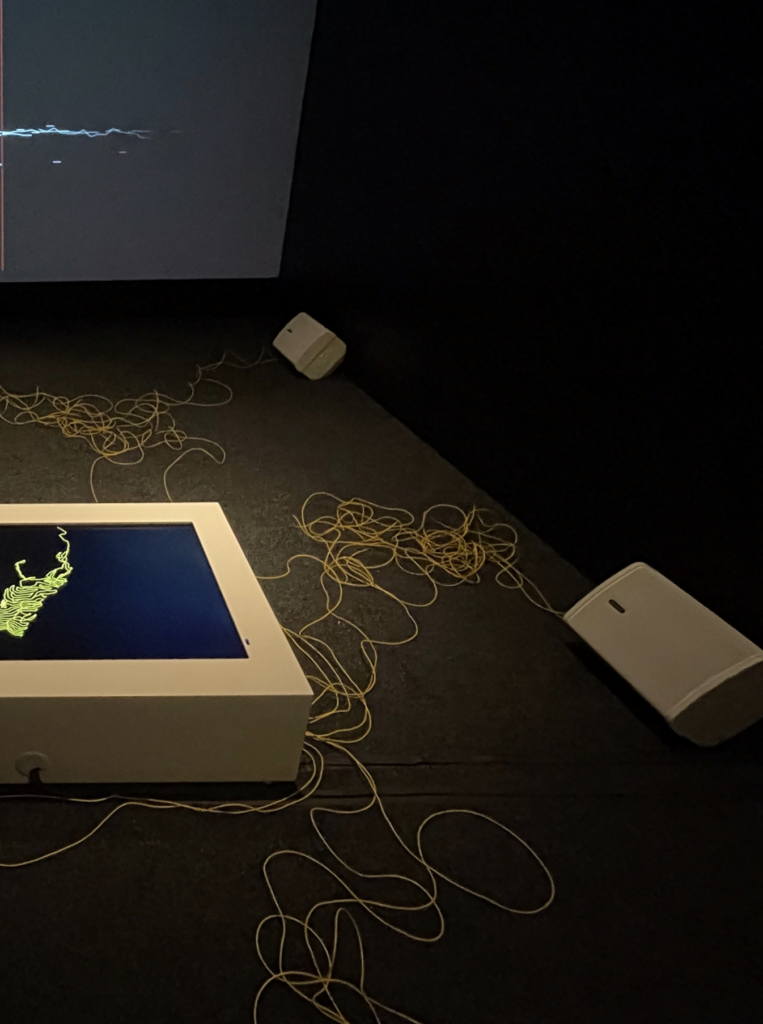
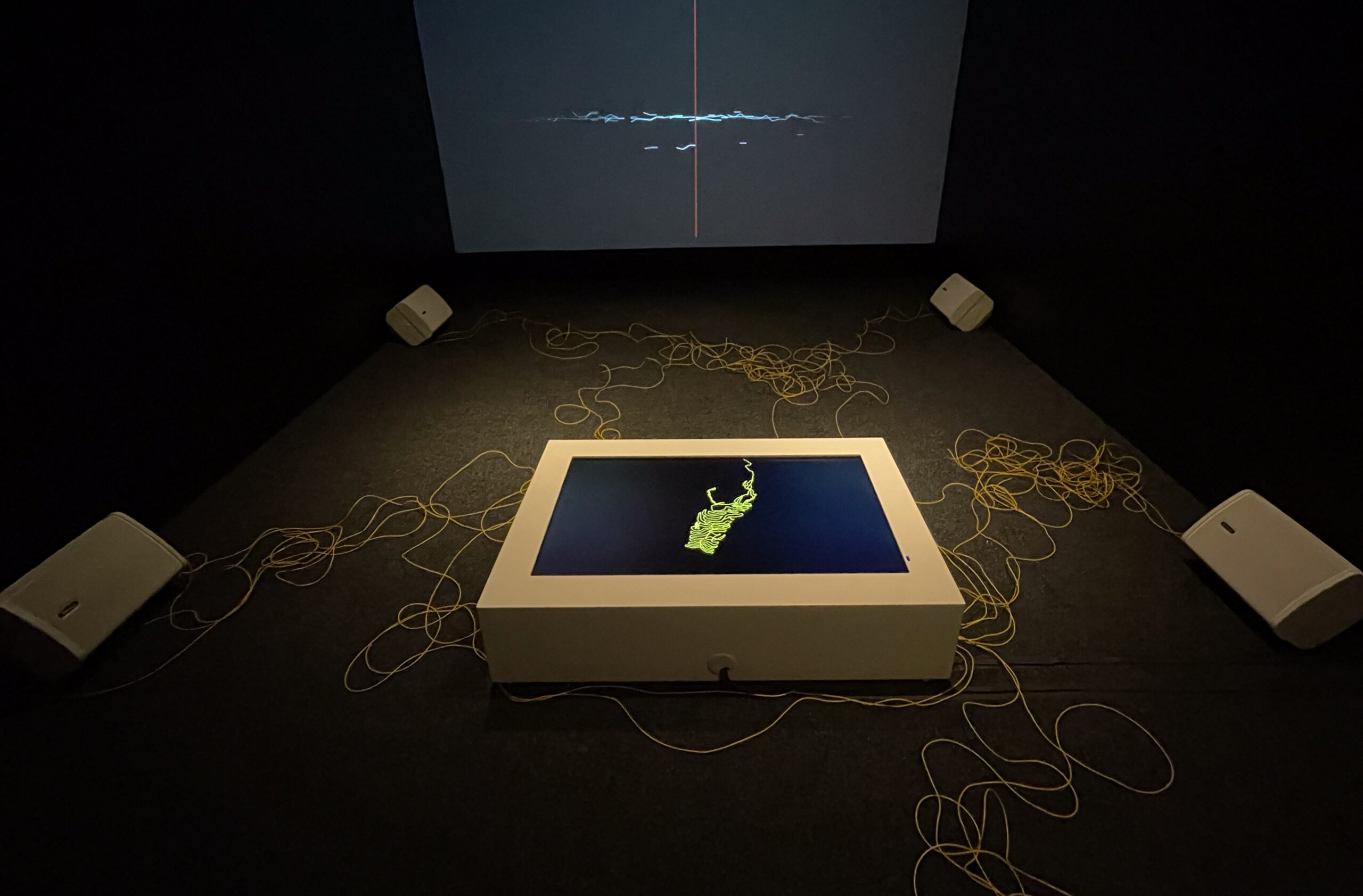
Soundings recreates the several-week-long route in northern Greenland exactly as the icebreaker Oden moved and collected data. The work consists of different parts which relate in different ways to the expedition’s journey and its collected data. It focuses on two different approaches to the raw scientific data that underpins the scientific study and analysis of the seabed: the relationship between raw data and scientific statement.
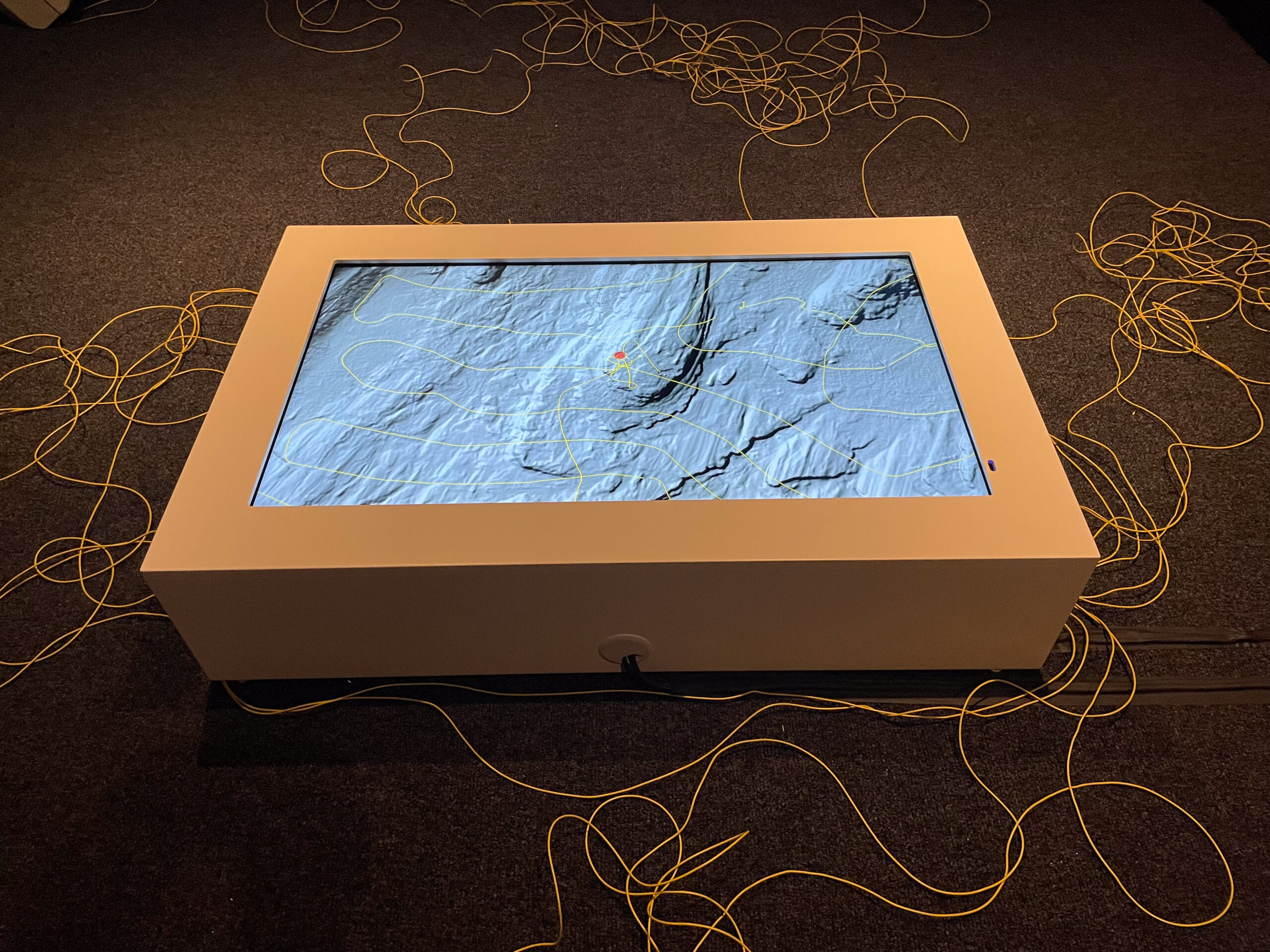
One part of the work shows the processed scientific map image of the Arctic seabed at Ryder Glacier provided by the scientists. Also visible here is a yellow emerging line showing the research vessel Odin’s route over time, moment by moment becoming its own abstract landscape.
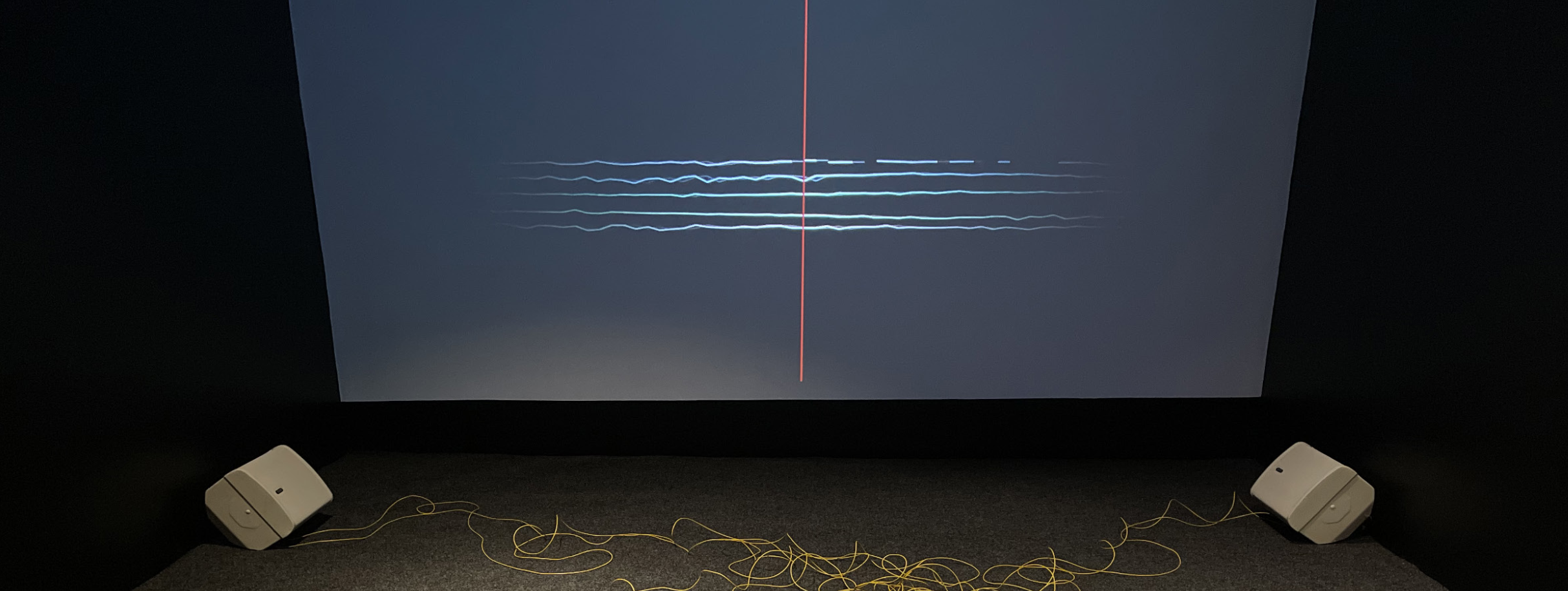
Synchronized with the map image and its route, a projection appears at the far end of the exhibition space, along with a layer of sound coming from different speakers in the room. In the work, five points or lines from the four hundred points of the multibeam sonar have been isolated and can be seen and heard in the work. These are based on the raw data that forms the basis of the scientific map, but are reproduced here with all the technological “inaccuracies” that the scientists in the visualization have removed. Sudden silences and hiccups reveal stretches of the journey and the collecting of data where, for various reasons, the technologies have failed to measure.
In this way, the exhibition juxtaposes the scientific map with the obscure conditions of the technologies, side by side, and turns it into a sensory, visible and audible experience.
CREDITS:
Martin Jakobsson, professor of marine geology and geophysics, Department of Geological Sciences, Stockholm University, expedition leader Ryder 2019.
Andre Bartetzki, programmer.
Helena Wikström, curator, Vita Kuben / Norrlandsoperan, Sweden.
Soundings is part of the artistic research project Sonic Visions of the Arctic funded by the Swedish Research Council.